

Signed in as:
filler@godaddy.com
I specialize in art-based wellness sessions that help clients visually process inner experiences using spontaneous, non-interpretive image-making. I create a space where clients can engage with their inner imagery safely and meaningfully—often accessing insight and resolution that words alone can’t reach. I also co-facilitated therapy sessions with licensed therapists in a therapeutic setting, where my role is focused on guiding expressive, process-based art exploration.
This is a visual and somatic expressive arts process that helps participants externalize, engage, and reflect upon inner experience without relying solely on verbal processing. Using fluid painting, spontaneous mark-making, and guided pareidolia—the recognition of meaningful forms within ambiguity—participants interact with emergent imagery in a way that supports neuroplasticity, symbolic exploration, embodied awareness, and creative meaning-making.
Rather than beginning with predetermined imagery or fixed interpretation, the process allows forms to emerge organically through interaction between perception, imagination, concept, and material. The artwork becomes a dynamic space for exploration, reflection, and transformation.
Rather than simply replicating what already exists, pareidolia-based art actively shapes and transforms our understanding of the world, introducing new perspectives, concepts, and emotions that may not have been previously recognized. It is a dynamic system that synthesizes various inputs—memories, emotions, sensory experiences, and cultural influences—into entirely new forms. This generative aspect enables clients to explore complex themes, abstract ideas, and emotional landscapes that are not directly observable in their everyday lives by engaging with shapes, colors, and textures that evoke emotions and thoughts in novel ways.
Rather than being confined to traditional definitions of artistic success, Pareidolia-based art is seen as a process of exploration and discovery that embraces uncertainty and spontaneity. This perspective aligns with the principles of emergentism, where creativity is viewed as an evolving interplay of influences, leading to the formation of complex, meaningful patterns that enrich our understanding of ourselves and the world. This process reveals how we shape our perceptions and experiences, emphasizes our active role in generating new meanings and possibilities.
Emotions, memories, intuitions, bodily sensations, and symbolic impressions are often experienced visually, somatically, or atmospherically before they can be translated into language.
→ This process provides a direct, nonverbal way for participants to engage and externalize those experiences through image, gesture, texture, and form.
→ Participants can remain connected to subtle or ambiguous experiences without needing to immediately explain or define them cognitively.
By beginning with spontaneous, unplanned painting or fluid mark-making, participants engage uncertainty and ambiguity directly rather than trying to control the outcome from the beginning.
→ Through guided pareidolia, recognizable forms gradually emerge from abstract marks, allowing symbolic content to arise naturally through the creative process itself.
→ This supports imaginative flexibility, associative thinking, and deeper engagement with subconscious or emotionally resonant material without forcing interpretation.
The tactile, sensory, and movement-based nature of painting encourages participants to remain connected to bodily sensation and present-moment experience.
→ The process engages rhythm, gesture, texture, visual attention, and material interaction in ways that can support regulation, focus, and embodied awareness.
→ Rather than remaining solely in abstract reflection, participants interact physically with evolving forms and imagery through direct creative engagement.
Participants are not asked to immediately determine what an image “means.” Instead, they are encouraged to observe how forms shift, evolve, and resonate over time.
→ Multiple interpretations can coexist within the same image.
→ This reduces performance pressure and avoids collapsing ambiguous experiences into rigid narratives prematurely.
→ Meaning emerges through sustained interaction with the artwork rather than through externally imposed analysis.
Rather than illustrating predetermined ideas or imagery, participants engage ambiguous visual fields until forms emerge relationally through perception and imagination.
This transforms spontaneous mark-making into an active dialogical process between:
The process does not begin with a fixed image to reproduce. Instead, imagery unfolds gradually through interaction with the surface.
This mirrors how many emotional, symbolic, and imaginative experiences arise in lived experience itself: dynamically, relationally, and often ambiguously.
Participants do not simply analyze inner experience intellectually. They engage it directly through:
The resulting artwork can function as an evolving visual anchor for continued reflection and dialogue.
The emphasis is not on producing aesthetically “successful” artwork or arriving at a single correct interpretation.
Instead, the process supports:
• As an expressive arts facilitation practice in individual or group settings
• Alongside talk-based therapy as a complementary nonverbal process
• Within contemplative, wellness, creativity, or arts-based community programs
• As a process-oriented tool for symbolic exploration and self-reflection
• In collaboration with therapists, expressive arts practitioners, educators, or facilitators
• With participants of all artistic experience levels; no technical art skill is required
• With emphasis placed on process, perception, and participation rather than artistic outcome or interpretation
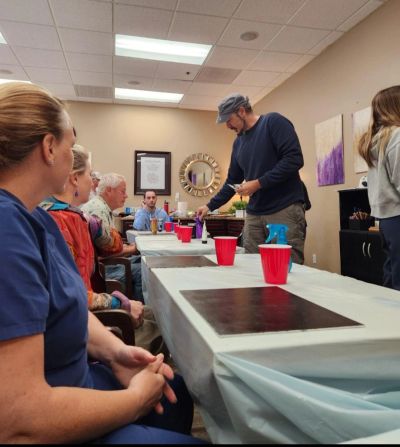
This is a visual and somatic expressive arts process designed to support individuals in addiction recovery by helping them externalize, engage, and reflect upon inner experiences without relying solely on verbal processing. Using fluid painting, spontaneous mark-making, and guided pareidolia—the recognition of meaningful forms within ambiguity—participants interact with emergent imagery in ways that support emotional expression, embodied awareness, symbolic exploration, and creative self-reflection.
Rather than focusing on fixed interpretation or artistic skill, the process creates a nonjudgmental space where meaning can emerge gradually through interaction with materials, perception, imagination, and the evolving image itself.
Recovery often involves emotions, memories, internal conflicts, cravings, shame, grief, or fragmented experiences that may be difficult to express directly through language.
→ This process offers participants a nonverbal and symbolic way to engage those experiences through image, gesture, texture, and form.
→ Participants can explore difficult material indirectly and safely through creative engagement rather than immediate verbal disclosure.
By beginning with spontaneous, unplanned painting or fluid mark-making, participants enter a process that mirrors the nonlinear and often unpredictable nature of emotional experience itself.
→ Through guided pareidolia, recognizable forms gradually emerge from ambiguity, allowing participants to encounter symbolic or emotionally resonant imagery without needing to consciously invent or control it.
→ This can support self-reflection, emotional insight, and imaginative flexibility while reducing performance pressure and over-intellectualization.
The tactile and sensory nature of painting encourages connection with bodily sensation, movement, rhythm, and present-moment awareness.
→ The process supports grounding through direct interaction with materials, gesture, texture, and visual attention.
→ Rather than remaining solely in abstract thought or rumination, participants engage physically and perceptually with evolving imagery and creative process.
Participants are not required to immediately explain or define what their imagery “means.”
→ Forms are allowed to shift, evolve, and hold multiple meanings simultaneously.
→ This can reduce shame, defensiveness, or fear of being psychologically “analyzed.”
→ Meaning unfolds gradually through sustained interaction with the artwork rather than through externally imposed interpretation.
• Uses pareidolia as a creative and reflective tool.
Participants engage spontaneous marks, washes, and textures until imagery begins to emerge relationally through perception and imagination. The process transforms ambiguity into a dynamic dialogue between material, perception, memory, emotion, and symbolic form.
• Emphasizes emergence rather than predetermined outcomes.
Rather than illustrating a fixed idea or producing aesthetically “correct” artwork, participants allow forms and meanings to develop gradually through interaction with the surface and evolving image.
• Encourages active participation rather than passive reflection.
Participants engage emotionally and physically through movement, attention, visual exploration, and creative response, creating tangible visual anchors that can support continued reflection and discussion.
• Process-oriented rather than interpretive.
The emphasis is not on diagnosing, decoding, or explaining imagery immediately. Instead, the process supports attentiveness, imaginative openness, emotional engagement, and creative exploration over time.
• As an expressive arts facilitation practice within addiction recovery programs or wellness settings
• Alongside talk-based therapy as a complementary nonverbal process
• In individual or group-based recovery support environments
• As a contemplative and creativity-based practice for emotional regulation and self-reflection
• In collaboration with therapists, counselors, recovery specialists, or expressive arts practitioners
• With participants of all artistic experience levels; no technical art skill is required
• With emphasis placed on process, participation, and embodied engagement rather than artistic outcome or interpretation

This is a visual and somatic method for integration that helps clients externalize, organize, and process what arose in their ketamine session—without relying solely on verbal processing. The technique uses visual art (especially fluid media) and a guided process of recognizing images in abstract marks (pareidolia) to anchor psychedelic content in physical, symbolic form.
Clients often describe their ketamine journeys as filled with images, symbols, archetypes, emotions, or body-based sensations that are difficult to articulate afterward.
→ This method gives them a direct way to express and retain those impressions without needing to explain them verbally.
By starting with spontaneous, unplanned painting or mark-making, the client mimics the open, nonlinear nature of the psychedelic state.
→ Then, by visually “finding” forms inside the chaos (faces, bodies, animals, etc.), the client recognizes inner content organically, just as it arose during their journey.
→ This strengthens memory consolidation, allows for symbol-based meaning-making, and prevents premature rationalization.
The physical process of painting (fluid, sensory, embodied) is calming to the nervous system and supports reentry from altered states.
→ Rather than staying in the abstract, the client connects through body movement, texture, and sensation—anchoring their insights.
Clients don’t have to “make sense” of their experience right away. They are invited to notice what forms emerge, and let meaning arise over time.
→ This avoids retraumatization or over-intellectualization of sensitive content. It respects the ambiguity of deep inner work.
• Uses visual pareidolia as a tool for integration.
Instead of creating from imagination or copying what they saw, clients engage with random marks or washes until subconscious imagery reveals itself. This mirrors the way content appeared in the altered state—and reinforces it in the nervous system.
• Respects the emergent, nonlinear nature of psychedelic insights.
Most traditional integration approaches rely on narrative or verbal reflection. This method embraces visual, symbolic, and intuitive modes of meaning-making, which are often more aligned with psychedelic content.
• Encourages active co-creation, not passive reflection.
The client doesn’t just “think about” what happened. They engage with it physically, artistically, and reflectively—creating a visual artifact of their process that can serve as an anchor or touchstone for further therapy.
• Somatic, not interpretive.
It’s not about “understanding what it means” right away. It’s about connecting with what arose and letting it settle into the body and psyche in a lasting, integrated way.
• Designed as a post-session integration practice (24–72 hours after the ketamine session)
• Can be used in tandem with talk-based integration or as a stand-alone expressive processing tool
• Led by an arts facilitator, in collaboration with the client’s therapist or guide
• All content remains client-centered, non-directive, and trauma-sensitive
• No artistic skill is required; focus is entirely on process, not outcome